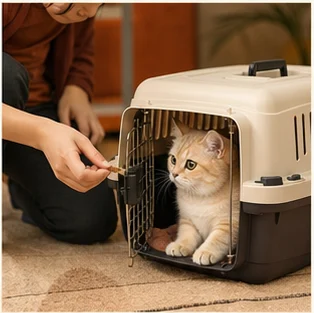
Boarding or home care: choose around your cat's temperament
Compare what an actual sitter and an actual boarding provider can deliver for this cat, rather than declaring one service label universally better.

Keeping familiar surroundings may matter, but so does reliable care. Home visits and boarding can leave different gaps. Put the cat's needs beside specific provider answers, including the times when nobody will be directly responsible.
Field notes
- Start with the individual care needs.
- Compare real supervision.
- Check health-instruction capability.
- Keep unanswered questions visible.
01List what must continue
Write the cat's usual food, resource access, contact preferences and any instructions issued by its vet. Describe past responses to change as observations, not a fixed temperament rating.
Include what the household cannot leave unattended, such as an uncertain medicine handover. If needs are unclear, ask the veterinary team before choosing the service model.
02Compare real coverage
For home care, ask who attends, what each visit includes and what happens between visits. For boarding, ask who supervises and how care works when the usual staff are absent.
Do not assume home care means continuous company or boarding means continuous observation. Request a written description for the exact booking rather than relying on a general advertisement.
03Check ability, not reassurance
Ask each provider whether it can follow the actual feeding and veterinary instructions. Let it identify tasks it cannot carry out; an honest limit is useful decision information.
If a task requires clinical skills or clarification, discuss an appropriate arrangement with the vet. A promise to love animals does not demonstrate that a particular care instruction can be delivered.
04Plan exceptions and access
Agree who is called if the cat seems unwell, who may authorise further care and how transport will be arranged. Ask what happens if a sitter cannot enter or a boarding placement cannot continue.
Share necessary access details privately with the chosen person, not publicly in a comparison sheet. A backup contact should know that they have been assigned the role.
05Choose from a written matrix
Use two columns with the same rows: care tasks, actual coverage, unresolved health questions, emergency process, dated quote and cancellation terms. Leave amounts as VND ___ until a real quote is received.
If neither option meets a key need, record that rather than awarding a winner. Reconsider the arrangement with professional advice or a different provider before treating the comparison as a booking.
Questions to take with you
Ask before deciding
- What happens outside the stated care times?
- Which instruction can you not carry out?
- Who provides backup if this arrangement fails?
A practical sequence
- List non-negotiable tasks.
- Collect comparable answers.
- Resolve critical gaps before booking.
This is an individual care-model comparison, not a provider endorsement, universal visit schedule or claim that PAVI books care.
Sources and how to use this guide
These sources support the principles in this guide. It has not had a veterinarian’s clinical review, and it is not a facility inspection or a service-quality certification.