A safe base for a cat: one small territory before the whole home
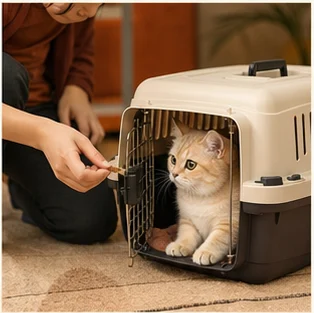
Design a dependable place within your existing home where your cat can rest, access resources and choose distance.
A home base is not only a room for a newly arrived cat. It is an everyday arrangement that remains usable when the household becomes busy. Judge it from the cat’s routes and choices, not from how coordinated the furniture looks.
What to take away
- Map access as well as the location of objects.
- Provide choice without forcing contact with people or animals.
- Recheck the arrangement when the household changes.
01Start from where the cat already goes
Observe where the cat rests, hides, watches and passes through the home. Mark those places on a rough floor plan and note which are available throughout the day, rather than only when a particular door happens to be open.
Do not remove a preferred hiding place just because it is inconvenient to see the cat there. First ask whether it is safe and whether a suitable alternative is available; visibility to people is not the only measure of a good space.
02Separate resources from bottlenecks
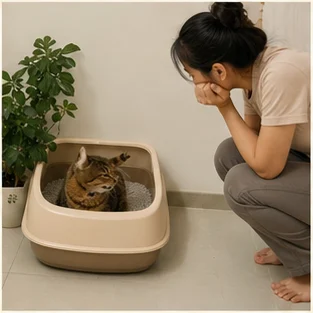
Look at the paths to food, water, litter and rest. A resource may be present but difficult to use if the cat must pass a dog, another cat or constant household traffic to reach it.
In a shared apartment, mark doors that cleaners or guests sometimes close. Ask each caregiver to trace the cat’s route at the busiest time of day. This often reveals a practical access problem that buying another accessory would not solve.
03Offer usable hiding and height
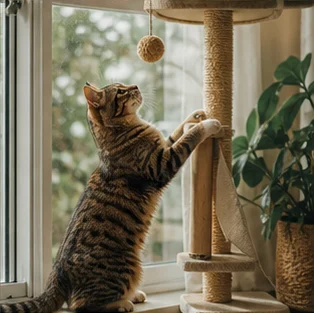
Provide appropriate protected resting and viewing options, making sure the structures are stable and the cat can reach and leave them. Do not assume every cat can comfortably use the same jump or climb.
If familiar routes become difficult, ask the veterinary team about the change and appropriate adaptations. Moving resources can support access, but it should not be used to explain away a possible mobility or pain concern.
04Protect choice during household activity
Tell people which spaces should remain undisturbed and avoid pulling the cat out to greet visitors. In a multi-animal home, check whether the apparent quietness reflects genuine access or one animal avoiding another.
Separate options may be more useful than arranging all belongings in one attractive pet corner. Observe actual use over ordinary days; the cat does not need to approve your design by sleeping in the bed you purchased.
05Review a small change
When furniture, work patterns or household membership changes, revisit the map before reorganising everything. Change one practical feature where possible and note whether access becomes easier.
A room note can use “Resting place [ ]; route to water and litter [ ]; doors to keep open [ ]; undisturbed space [ ].” Make it useful for cleaners and caregivers. A good base remains usable by the cat, rather than preserving a layout that never adapts.
Questions to take with you
Questions you can use
- Can my cat reach essential resources without passing a conflict point?
- Which doors or household activities make the base unreliable?
- Does a new access difficulty need a veterinary discussion?
This guide supports preparation and conversation, not diagnosis or veterinary treatment. Contact a veterinary provider for health concerns or possible emergencies; do not delay care to complete a checklist.
Sources and how to use this guide
These sources support the principles in this guide. It has not had a veterinarian’s clinical review, and it is not a facility inspection or a service-quality certification.