Cat enrichment at home: height, hiding, and play rhythm
Offer an indoor cat meaningful choices for play, exploration and rest without making the home constantly busy.
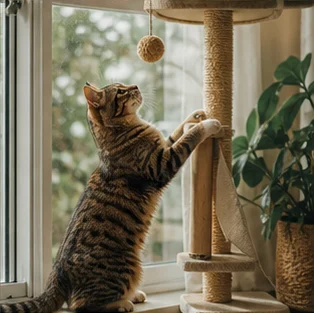
A cat’s useful activity menu is shaped by what it chooses, where it feels comfortable and what it can physically do. Enrichment should add opportunities, not turn every quiet moment into a demand to perform for a person.
What to take away
- Observe preferences before adding new purchases.
- Supervise play materials and store unsuitable items safely.
- Keep a quiet recovery space available.
01Map the cat's own choices
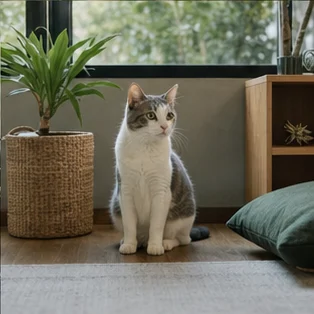
Notice favourite viewing places, scratching locations, hiding spots and routes through the room. Record what the cat actually uses rather than measuring the home by the number of products advertised for cats.
Include times when the cat declines interaction. A change from its ordinary behaviour is worth noting, but do not diagnose boredom from a single unused toy or assume every reduced activity needs a more exciting game.
02Separate play from protected rest
Choose a play area where movement will not require dodging clutter or disturbing another animal. Preserve somewhere the cat can retreat without being followed by the toy or by enthusiastic family members.
In a small apartment, the same room can serve different purposes at different times. Agree when a floor space is available and keep access to ordinary resources clear; activity should not block the path to water or litter.
03Select materials for this cat
Use suitable toys in good condition and supervise items with strings, small attachments or parts that could be swallowed. Put them away when the interaction ends instead of assuming a toy is safe unattended because it was sold for cats.
Keep medicines, cleaning packaging and unrelated household objects out of the game. If a concerning item may have been swallowed, contact a veterinary provider; do not treat continued play as proof that nothing happened.
04Follow the response during interaction
Offer a manageable invitation and observe whether the cat engages, watches or leaves. Adjust the activity to its ability and preference rather than insisting on repeated jumping or a fixed amount of movement.
Let a session end without chasing the cat to restart it. If food is part of a supervised search or puzzle, keep it appropriate to the existing feeding plan and record it with other food offered.
05Rotate opportunities with a purpose
Keep a short menu of options that have actually worked and change one feature when interest fades. A different suitable location or style of interaction may be more useful than replacing every toy at once.
A choice note can read “Likes watching [ ]; likes playing [ ]; preferred rest spot [ ]; items to put away after play [ ].” Share it with a caregiver. Ask the veterinary team about persistent changes or physical difficulty; more activity cannot replace a health assessment.
Questions to take with you
Questions you can use
- Which activities does my cat choose rather than merely tolerate?
- What must be supervised and stored away after play?
- Is a change in participation a practical preference or a concern to discuss?
This guide supports preparation and conversation, not diagnosis or veterinary treatment. Contact a veterinary provider for health concerns or possible emergencies; do not delay care to complete a checklist.
Sources and how to use this guide
These sources support the principles in this guide. It has not had a veterinarian’s clinical review, and it is not a facility inspection or a service-quality certification.