The litter box: what to observe before changing everything
Keep toileting observations useful and the litter setup accessible, without mistaking a possible urinary problem for bad behaviour.
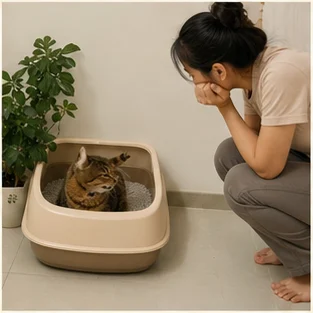
If your cat is straining with little or no urine, seems unable to urinate or appears unwell, contact a veterinary provider immediately. Do not wait to clean, change the litter or finish a diary first. A possible urinary obstruction is an emergency.
What to take away
- Describe what you saw, including what remains unknown.
- New toileting problems need a veterinary conversation.
- Environmental changes do not replace assessment of possible illness.
01Record the change without blame
Note when you first noticed a different location, pattern or apparent difficulty. Describe what was actually seen rather than deciding the cat is protesting, dirty or deliberately inconveniencing the household.
In a multi-cat home, say when you do not know which animal used a box. Do not turn a guess into a named medical history. Contact the clinic with uncertainty if necessary; perfect identification is not a prerequisite for asking for urgent advice.
02Map each box and its access
Draw where boxes are, how the cat reaches them and whether doors or other animals can block the route. Include the entry height and surrounding space in your description without assuming one layout suits every cat.
For an apartment, check whether a bathroom door closes during work calls or a cleaner moves the tray. A box can exist in the home but be unavailable at the moment the cat needs it.
03Describe the current routine accurately
Record the actual litter product, recent changes, cleaning products and how the household handles daily maintenance. Keep labels where useful and avoid altering several factors before you can explain what changed.
Ask the veterinary team about appropriate cleaning and setup when there is a problem. Do not mix household chemicals or use a stronger fragrance as a solution to unexplained toileting changes.
04Bring concerns to the clinic promptly
Tell the team about straining, apparent discomfort, changes in urine or stool and any other observed change in the cat’s ordinary behaviour. You do not need to decide which disease might explain them.
If the clinic requests a sample or particular observations, ask exactly how it wants them collected. Do not delay a needed visit to obtain a sample, or try to press the abdomen or otherwise force urination at home.
05Review one environmental adjustment
After seeking appropriate assessment, discuss a practical change such as access, location or the type of box. Keep the treating team’s plan primary and note whether the cat can use the revised setup.
A record can use “Change observed [ ]; cat involved or unknown [ ]; tray location [ ]; product [ ]; clinic contact made [ ].” It supports follow-up without prescribing a diet, medicine or waiting period. A cleaner floor alone does not prove the underlying problem has resolved.
Questions to take with you
Questions you can use
- Does this observed change require assessment now?
- What information about the box, litter and access would help you?
- If a sample is needed, how do we collect it without delaying care?
This guide supports preparation and conversation, not diagnosis or veterinary treatment. Contact a veterinary provider for health concerns or possible emergencies; do not delay care to complete a checklist.
Sources and how to use this guide
These sources support the principles in this guide. It has not had a veterinarian’s clinical review, and it is not a facility inspection or a service-quality certification.