Cat meals: consistency can matter more than complexity
A useful feeding routine makes the current plan visible to everyone without turning a package guide into a prescription.
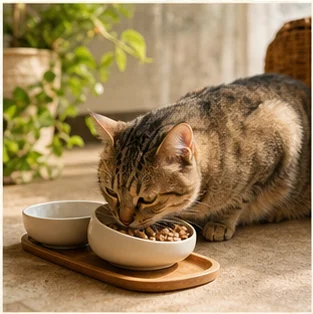
When several people care for a cat, the missing information is often not a new food recommendation but who served what. Start with the diet your veterinary team has discussed, and make changes a conversation rather than a household experiment.
Field notes
- Name the exact food and variant.
- Separate serving from confirmed eating.
- Use one shared handover.
- Ask about an appetite change.
01Identify today's food
Put the product name, formulation and package photo beside the feeding record. Include treats and food used with medicines so the next carer sees the whole picture.
If the previous carer cannot identify something, write unknown. A similar-looking bag is not evidence that you have found the same diet.
02Give each cat a visible place
Draw the actual feeding locations, including where one cat can reach another's bowl. Ask your vet about a workable arrangement if individual diets or competition complicate meals.
The drawing is a household coordination tool, not a rule that all homes need identical furniture. Watch whether each cat can use its own arrangement.
03Record portions and leftovers
Use the unit in the agreed plan and note what was offered separately from what you saw eaten. An empty shared bowl cannot tell you which cat ate the food.
A blank handover can read: date ___; cat ___; food ___; amount offered ___; observed leftovers ___; carer ___. Do not fill the quantity from an online example.
04Make substitutions a question
If the usual product is unavailable, photograph the alternative label and contact the treating team when dietary advice is individual. Do not assume an identical flavour name means an identical formulation.
For a Vietnamese shop or clinic, send the package image with the exact product name. Ask the clinic to confirm any revised feeding instructions in writing.
05Do not label change as fussiness
A new reduction in eating deserves veterinary advice rather than an argument about whether the cat is being difficult. Bring the offered-and-eaten record, not a diagnosis.
Do not withhold food to prove a preference or force-feed from this guide. The clinic should direct the next steps; the record must not delay contacting it.
Questions to take with you
Ask before deciding
- Who owns the next meal and how will they mark it done?
- Does this cat need an individual location or diet?
- Who should we contact if the usual food is unavailable?
A practical sequence
- Agree the current plan.
- Label the food record.
- Use one meal handover.
This is feeding organisation, not a diet prescription. Individual amounts and health concerns belong with a veterinarian.
Sources and how to use this guide
These sources support the principles in this guide. It has not had a veterinarian’s clinical review, and it is not a facility inspection or a service-quality certification.