Before dog boarding: prepare information and familiar items
Prepare an already chosen stay with a clear admission check, labelled belongings and a workable communication plan.
Once you have chosen a boarding provider, the next job is an accurate handover for this dog. A friendly booking conversation is not the same as confirming current admission requirements, medication capability or what happens when a caregiver cannot be reached.
What to take away
- Confirm the written requirements for this stay.
- Share current instructions in their original form.
- Agree who can decide and who collects the dog.
01Confirm admission before packing
Ask the exact branch to send its current requirements and check them against your dog’s actual records. Clarify arrival and collection arrangements, any trial or assessment process and circumstances in which the stay may not proceed.
Do not assume another branch or a previous stay had the same rules. If the provider asks for a health-related action, discuss it with the veterinary team rather than changing treatment or arranging a procedure solely from an ambiguous message.
02Write a current care handover
Describe the usual food, rest, toilet opportunities and relevant handling preferences in practical terms. Say what the dog actually needs, not only that it is easy or friendly.
Provide current medication instructions from the issuing clinic and ask whether the provider can follow them. Do not decant medicines into unlabelled containers, rewrite doses from memory or treat willingness to help as evidence of clinical capability.
03Pack only agreed essentials
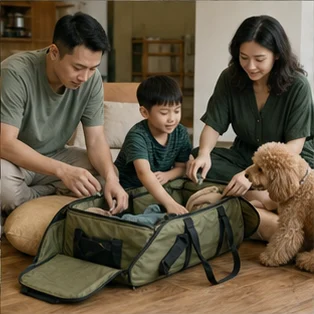
Ask what the provider supplies and what it permits you to bring. Label appropriate food, equipment and belongings with the dog’s name, and keep an inventory so both parties know what was received.
A packing note can say “Item [ ]; quantity [ ]; attached instructions [ ]; receipt confirmed by [ ].” Familiar items may help when suitable, but they cannot guarantee a stress-free stay or replace supervision.
04Agree contacts and decisions
Confirm the main contact, a consenting backup and the provider’s process if the dog becomes unwell. Ask how veterinary care is arranged, how costs are discussed and what it will do if nobody answers promptly.
Clarify the channel and realistic pattern for ordinary updates separately from urgent contact. Do not infer continuous observation from a promise of photographs, or assume a video feed means a staff member is watching at every moment.
05Plan collection as another handover
Confirm who may collect, how identity is checked and how any change to pickup arrangements should be communicated. Ask for a summary of eating, rest, incidents and any care given during the stay.
Compare returned belongings with your list and clarify new instructions before leaving. If health concerns arise during or after the stay, seek veterinary advice without waiting for a perfect report. The goal is continuity of care, not merely checking out on time.
Questions to take with you
Questions you can use
- Can you send this branch’s current admission and medication requirements?
- How will urgent veterinary decisions and unreachable contacts be handled?
- What written handover will I receive at collection?
This guide supports preparation and conversation, not diagnosis or veterinary treatment. Contact a veterinary provider for health concerns or possible emergencies; do not delay care to complete a checklist.
Sources and how to use this guide
These sources support the principles in this guide. It has not had a veterinarian’s clinical review, and it is not a facility inspection or a service-quality certification.