Puppy socialisation: small, safe experiences with choice
Build a plan for positive everyday experiences while discussing health and exposure choices with your veterinary team.
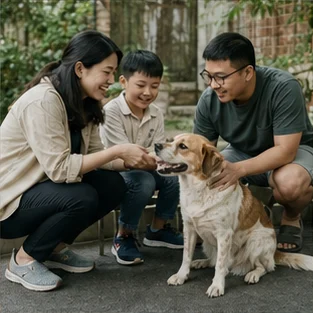
Socialisation is not a contest to meet the most people or dogs. The useful question is whether a puppy can experience something manageable and leave without being overwhelmed. Health precautions and behavioural learning belong in the same plan.
What to take away
- Agree exposure choices with the veterinary team.
- Observation can be a useful experience without contact.
- Choose humane classes with clear welfare controls.
01Discuss health before choosing settings
Bring the puppy’s actual records and describe the places you hope to visit. Ask the vet how the puppy’s health and local exposure concerns affect those choices, rather than applying an online age or vaccination rule to every setting.
AVSAB supports safe early socialisation, while veterinary vaccination guidance addresses individual clinical decisions. Neither means every pavement, group or unknown animal is an appropriate destination for your puppy today.
02Choose experiences from real life
List the things the puppy will encounter at home: different people, household sounds, a carrier or car, a lift and ordinary grooming preparation. Pick a manageable version of one experience rather than a busy location containing everything at once.
For an apartment household, the first question might be whether the puppy can observe the lift area calmly with a responsible adult. You do not need to enter a crowded lift merely to mark it completed.
03Let participation remain optional
Begin with enough distance and a simple setting, using reward-based encouragement. Allow the puppy to observe or move away; avoid passing it between strangers or bringing it face to face with unfamiliar animals.
If the puppy becomes withdrawn, avoids the situation or appears overwhelmed, make the experience easier or stop. The lesson is not improved by holding the puppy there until the planned time is over.
04Record the experience, not a score
Note the setting, what the puppy chose to do, whether it could disengage and what happened afterwards. This helps you decide whether the next attempt should be quieter, farther away or supported by a professional.
Use a small ladder: “Observe from [place] → approach if comfortable → finish before pressure builds.” Leave steps unfinished when necessary. A list with fewer good experiences is more useful than a full checklist of distressing encounters.
05Choose a class by its process
Ask how a class checks entry health information, manages group size and separates puppies that need space. Find out what happens when a puppy is frightened and whether the trainer welcomes observation and questions.
Ask for reward-based methods and verify the trainer’s actual education or credentials without treating a badge as a guarantee. A provider who cannot explain handling, hygiene or stopping an exercise has left important questions unanswered.
Questions to take with you
Questions you can use
- Which environments are appropriate for this puppy’s current health history?
- Can my puppy observe without joining the group?
- What does the trainer do when a puppy needs more distance or a break?
This guide supports preparation and conversation, not diagnosis or veterinary treatment. Contact a veterinary provider for health concerns or possible emergencies; do not delay care to complete a checklist.
Sources and how to use this guide
These sources support the principles in this guide. It has not had a veterinarian’s clinical review, and it is not a facility inspection or a service-quality certification.