Dog enrichment at home: begin with the daily rhythm
Create a small menu of suitable activities that gives your dog choices without filling every quiet moment.
Enrichment is not a pile of new toys or a plan to exhaust a dog. It is a way to offer worthwhile things to investigate, learn or enjoy in the home you actually have. Rest and the option to stop remain part of a good day.
What to take away
- Start from what your dog chooses to do.
- Check materials, supervision and food use.
- Evaluate engagement, not how tired the dog looks.
01Notice existing preferences
Observe whether the dog enjoys investigating smells, interacting with you, carrying a suitable toy or learning a familiar cue. Use those preferences as a starting point rather than buying the most complicated puzzle available.
Record what the dog leaves untouched too. Lack of interest is not failure, and a sudden change in ordinary activity should not automatically be explained as boredom when a veterinary question may be needed.
02Offer different kinds of activity
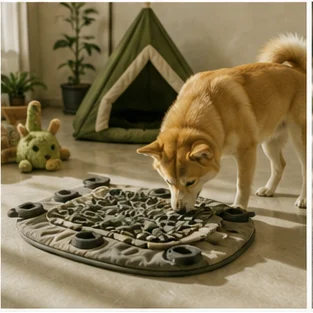
A simple menu might include supervised searching for part of an appropriate food allowance, gentle reward-based practice and a suitable toy session. Choose activities compatible with the dog’s care plan and physical ability.
Keep the resting space available throughout. In a small living room, clear a defined floor area and tell other people when it is in use, so the activity does not collide with cooking, deliveries or children’s play.
03Check the object, not the marketing
Assess whether an item is suitable for this dog’s size, chewing and supervision needs. Inspect for damage and remove unsafe pieces. A product called enrichment is not automatically safe to leave with an animal.
Avoid turning medication containers, cleaning-product packaging or unknown materials into homemade toys. If a dog swallows or may have swallowed something concerning, contact a veterinary provider rather than waiting to see whether the activity still works.
04Make the challenge easy to adjust
Begin with a version the dog can engage with and simplify it if frustration grows. Change one aspect at a time so you can tell whether the activity became more appealing or simply more difficult.
If food is involved, note it alongside the rest of the day’s intake and ask the veterinary team about individual restrictions. Do not add unlimited treats or introduce unsuitable foods just to keep a puzzle interesting.
05Keep a menu rather than a timetable
Write three available options and select one that fits today’s weather, household activity and the dog’s interest. Rotate choices when useful without treating constant novelty as a requirement.
A shared menu can read “Supervised searching / Familiar cues / Suitable toy play / Rest.” Note what the dog enjoyed and what should change next time. Choosing to rest does not create a need for another task to complete the day.
Questions to take with you
Questions you can use
- What does my dog repeatedly choose when given a safe option?
- Can this item be used safely under our actual supervision?
- Does food used in play fit the dog’s current feeding plan?
This guide supports preparation and conversation, not diagnosis or veterinary treatment. Contact a veterinary provider for health concerns or possible emergencies; do not delay care to complete a checklist.
Sources and how to use this guide
These sources support the principles in this guide. It has not had a veterinarian’s clinical review, and it is not a facility inspection or a service-quality certification.