Reading dog body language: see the context, not one gesture
Learn to describe what your dog is doing in context, without turning one signal into a personality verdict.

Body language is most useful when it changes what you do next: give space, end an interaction or ask for help. It is not a way to prove that a dog will never bite, and a single photograph cannot explain an entire encounter.
What to take away
- Look at the whole animal and the surrounding event.
- Describe behaviour before assigning a label.
- Never provoke a reaction to complete an observation.
01Start with the whole scene
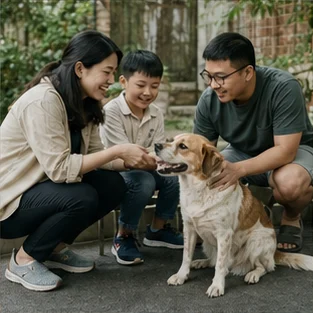
Notice what happened just before the behaviour: a hand reaching, a door opening, another animal appearing or a change in distance. Include whether the dog could move away, not just what its face looked like.
Then look across posture, movement, face and tail together. A wagging tail by itself does not establish that approaching is welcome. Build a description from several observations instead of treating one body part as a traffic light.
02Notice choices and changes
A dog may approach, turn away, become still or seek distance. Compare the current response with what you ordinarily see in a similar setting, while recognising that your interpretation can be wrong.
If the dog turns away during a greeting, make room rather than following to obtain a better reaction. A useful observation respects the animal’s ability to stop; it does not require touching, cornering or taking away an object.
03Change the situation, not the dog's warning
When an interaction appears uncomfortable, reduce pressure and create safe distance. This is different from insisting on obedience while the same person or animal continues approaching.
Avoid punishment for warning behaviour or training methods intended to intimidate. If safe handling is uncertain, keep people apart from the dog and seek an individual professional plan instead of trying increasingly forceful corrections.
04Write a description another person can use
Replace “bad with visitors” with a factual sequence such as “When the visitor entered the doorway, the dog moved behind the chair; when the visitor stopped approaching, the dog remained there.” This is an example format, not a diagnosis.
A shared note can use “What happened before / Observed behaviour / Distance / What happened after stopping.” Record only what occurred. An existing, safely captured video may help a professional, but never repeat a distressing encounter to film it.
05Know when interpretation is not enough
Bring sudden or persistent changes to a veterinary discussion, including any changes in ordinary eating, movement or rest that you have observed. Behaviour may need clinical assessment as well as training support.
If there is a risk of injury, prioritise separation and professional help. The aim is a safer response by the household, not a score that declares the dog friendly, dominant or fixed after one successful meeting.
Questions to take with you
Questions you can use
- What happened immediately before this response?
- Can the dog move away without being followed?
- Which observations should I bring to the vet or behaviour professional?
This guide supports preparation and conversation, not diagnosis or veterinary treatment. Contact a veterinary provider for health concerns or possible emergencies; do not delay care to complete a checklist.
Sources and how to use this guide
These sources support the principles in this guide. It has not had a veterinarian’s clinical review, and it is not a facility inspection or a service-quality certification.