Visitors and dogs: allow for respectful distance
Make the arrival plan clear to people so your dog does not have to manage an unpredictable doorway.
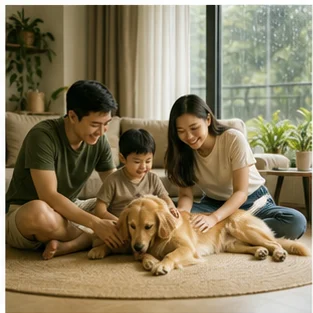
Having visitors does not require a dog to greet everyone. A successful visit gives people a clear entrance routine and gives the animal a comfortable option away from the gathering. Hospitality and a protected resting space can coexist.
What to take away
- Brief visitors before they arrive.
- Choose one adult to manage the entrance.
- A greeting is optional, not a test of friendliness.
01Send the useful instructions first
Tell visitors how to announce arrival and ask them not to open gates or reach towards the dog before you are ready. Explain the practical arrangement without labelling the dog naughty or asking guests to fix its behaviour.
Tell visitors, “Please message when you arrive and wait for me to open the door. You do not need to greet the dog straight away.” A clear message in advance is easier to follow than a hurried warning after the door opens.
02Assign the doorway and resting space
Choose an adult who is not simultaneously carrying food or welcoming every guest to manage the entrance. Prepare a suitable separate space with the dog’s ordinary needs met, and check that the separation actually works.
Let visitors know which door stays closed and which space is not part of the tour. If you cannot maintain safe separation, change the hosting arrangement rather than relying on a guest to hold a door indefinitely.
03Let contact happen without pressure
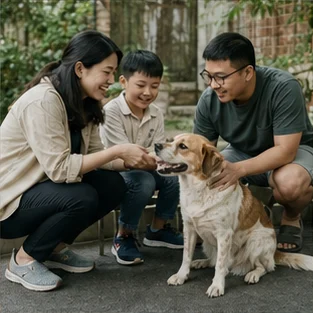
If a greeting is suitable, give the dog room to approach or remain at a distance. Ask people to follow your guidance and stop if the dog moves away or the interaction becomes uncomfortable.
Do not pull the dog into photographs, hugs or a circle of people to prove it is friendly. A quiet visit with no direct contact can still meet the needs of the household and the visitors.
04Plan children, food and divided attention
Adults need to actively supervise children around dogs and keep interactions appropriate. If attention must shift to cooking or conversation, use the prepared separation instead of assuming a familiar child and dog can manage alone.
Keep guest food and personal bags out of the dog’s reach, and ask guests not to feed without permission. Explain how treats fit the dog’s current plan rather than allowing several people to each offer an unrecorded extra.
05Review the arrival, not the dog's manners
Afterwards, note where the plan became difficult: a delivery during the visit, an opened door or a guest who did not understand the instructions. Change that part before the next gathering.
If there was marked fear, aggression or a new behaviour concern, seek veterinary or qualified behaviour support. Do not rehearse another crowded visit as a test. The result to improve is a predictable, safe interaction, not compulsory sociability.
Questions to take with you
Questions you can use
- Who opens the door while the dog has its own space?
- Can guests follow a no-greeting arrangement?
- When adults become busy, how will children and the dog be separated safely?
This guide supports preparation and conversation, not diagnosis or veterinary treatment. Contact a veterinary provider for health concerns or possible emergencies; do not delay care to complete a checklist.
Sources and how to use this guide
These sources support the principles in this guide. It has not had a veterinarian’s clinical review, and it is not a facility inspection or a service-quality certification.