Leash and calm: what to align before going outside
Make walking together a small learning task, with suitable equipment and rewards, before adding a busy street.
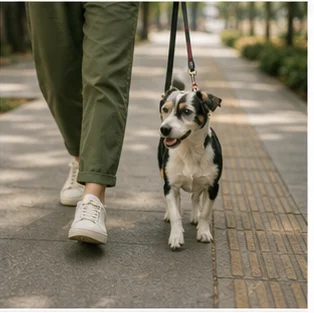
Loose-lead practice and getting to a destination are different jobs. A crowded pavement can demand more than a dog or handler is ready to learn. Begin where you can notice and reward the behaviour you want without having to complete a journey.
What to take away
- Ask for help with fit and safe handling.
- Practise in an easy setting before adding distractions.
- Do not use pain or intimidation to obtain a loose lead.
01Check the setup before the lesson
Choose appropriate equipment for the individual dog and ask a competent professional to check fit if you are unsure. Inspect fastenings and damage, and make sure the handler can use the setup comfortably.
Equipment is not a substitute for training or a promise that pulling will disappear. If the dog is painful, frightened by fitting or difficult to handle safely, seek veterinary or qualified training advice before pushing on.
02Choose a place where learning is possible
Start in a quiet, suitable area with room to move a few steps. Reduce competing demands so the dog can notice you; the first lesson does not need a destination or an audience.
In an apartment, use an appropriate private space rather than blocking a shared corridor. Keep exits secure and tell family members you are practising so someone does not unexpectedly open the door.
03Reward the position you want
Notice and reward moments when the dog attends to you and the lead is loose. Take a small number of easy steps and reward continued comfortable movement together, using something suitable that this dog values.
Avoid jerking the lead or dragging the dog into position. If maintaining a loose lead becomes difficult, stop the progression and make the setting easier. Reward-based learning is not improved by adding a painful correction between rewards.
04Increase only one difficulty
When a simple version is working, change one element such as the location or a modest distraction. Keep the practice brief enough that you can still observe the dog and finish without a struggle.
Do not add a busy road, unfamiliar dogs and a longer outing simultaneously. Needing an easier step in a new place is information about the task, not evidence that the dog is deliberately refusing everything it learned.
05Separate practice from a safety problem
Keep a note of where the dog could stay engaged and what caused the task to become difficult. Ask for help if pulling risks a fall, the dog becomes distressed or the handler cannot maintain safe control.
A practice record can read “Location [ ]; easiest step [ ]; reward [ ]; difficulty encountered [ ].” A professional can use it to plan suitable support. It is not a timetable promising a perfectly trained walk after a fixed number of sessions.
Questions to take with you
Questions you can use
- Does this equipment fit this dog and handler safely?
- What is the easiest version of walking together we can reward?
- Which difficulty should we remove before trying again?
This guide supports preparation and conversation, not diagnosis or veterinary treatment. Contact a veterinary provider for health concerns or possible emergencies; do not delay care to complete a checklist.
Sources and how to use this guide
These sources support the principles in this guide. It has not had a veterinarian’s clinical review, and it is not a facility inspection or a service-quality certification.