Senior dogs: notice comfort in familiar activities
Make everyday access easier while bringing new changes to a veterinary discussion rather than dismissing them as age.
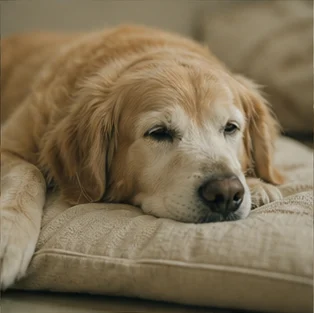
Comfort for an older dog is often visible in ordinary transitions: getting up, reaching a resting place or moving through a doorway. Notice which task has changed, then combine practical environmental support with appropriate clinical assessment.
What to take away
- Describe the activity that became harder.
- Do not assume every change is inevitable ageing.
- Evaluate one practical adjustment at a time.
01Observe a familiar day
Look at how the dog moves between bed, water, food, exits and toilet areas. Record a change in a specific activity rather than writing only “slowing down,” which gives another caregiver little to act on.
Use comparisons you genuinely know: a route the dog previously used, a doorway now avoided or a resting location that changed. Do not repeatedly ask the dog to perform a difficult movement to prove the observation.
02Map access and surface problems
Check whether a slippery transition, cluttered passage or awkwardly placed resource makes daily movement harder. Keep essential items accessible and protect a quiet place to rest without requiring the dog to negotiate household traffic.
In an apartment, include the path to the lift or usual outdoor toilet area. A comfortable bed is helpful only if the animal can reach and leave it; expensive equipment cannot replace attention to the route.
03Ask about the change, not just age
Bring new changes in mobility, behaviour, rest or ordinary routines to the veterinary team. Ask what should be assessed and how existing conditions or treatment affect activity and home arrangements.
Avoid treating a new difficulty as normal ageing by default or starting human pain medicines. If the dog appears acutely unwell or there is an urgent concern, contact a provider promptly instead of completing a home-improvement checklist first.
04Try one appropriate adjustment
Discuss suitable changes such as a clearer route, a stable nonslip surface or a different location for everyday resources. Any aid needs to suit the individual dog and home; ask for guidance when lifting, stairs or assistive equipment are involved.
Make one change you can observe safely and leave other variables steady where practical. The aim is easier voluntary access, not forcing the animal to use a new ramp or bed because it was bought for comfort.
05Review the result with the care team
Note whether the dog actually uses the adjusted route or resource and whether difficulty remains. Share observations at follow-up, including questions about care instructions that the household cannot implement consistently.
A room review can read “Task becoming harder [ ]; location [ ]; change tried [ ]; observation afterwards [ ].” Update it as needs change. Comfort support is an ongoing conversation, not proof that an underlying problem has been treated.
Questions to take with you
Questions you can use
- Which new changes need assessment rather than being attributed to age?
- What home adjustment fits this dog’s current mobility and care plan?
- How should we assess whether the adjustment is genuinely helping?
This guide supports preparation and conversation, not diagnosis or veterinary treatment. Contact a veterinary provider for health concerns or possible emergencies; do not delay care to complete a checklist.
Sources and how to use this guide
These sources support the principles in this guide. It has not had a veterinarian’s clinical review, and it is not a facility inspection or a service-quality certification.